Vladimir Putin's First Visit to Kuril Islands: Japan "Vigorously Protests"
Read our analysis of Vladimir Putin's first visit to the Kuril Islands and Japan's vigorous protest. Société Flash brings you live coverage.
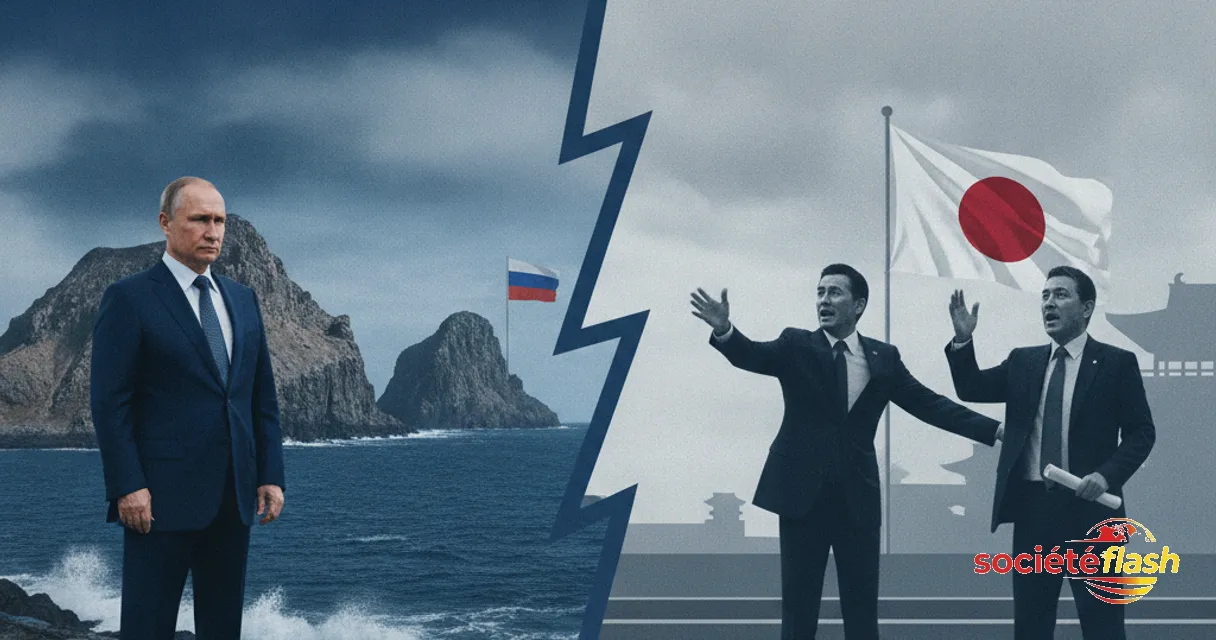
In a fast-paced world where news travels at lightning speed, relying on a trusted, expert news portal is essential. That is precisely the mission of Société Flash. Our editorial team breaks down major geopolitical events for you with unmatched accuracy. On Thursday, August 13, 2026, a major diplomatic event shook the international arena. Today's top headline: Vladimir Putin's First Visit to the Kuril Islands, Japan "Vigorously Protests". At Société Flash, we analyze the fallout from this highly symbolic move to provide you with clear, objective perspective.
Geopolitical news is often complex and requires specialized expertise. That is where our dedicated newsroom comes in. Under the strategic direction of Raphaël Graven, we break down every development for our readers. We do not simply relay basic wire dispatches. We analyze the specific words chosen by diplomats and contextualize historical events, helping you understand the real global stakes. As a discerning reader seeking clear answers, our platform is designed for a seamless reading experience. By turning to Société Flash, you join an informed community and gain access to exclusive insights on global crises.
Société Flash's Role in Covering International Crises
Our news portal is committed to providing verified reporting. Covering territorial disputes requires exceptional rigor, and the situation in the Far East is no exception. The longstanding tensions between Moscow and Tokyo demand meticulous follow-up. Our methodology ensures impartial coverage: we systematically cross-check our sources and examine official statements from each government.
Faced with events of this magnitude, in-depth analysis is paramount. International relations are often shaped by parallel conflicts. For example, the Russian offensive in Ukraine has fundamentally altered the global diplomatic balance. Our newsroom highlights these strategic connections, helping our readers connect the dots across global events. That is the distinct value of our news service.
Key Questions Regarding This Disputed Territory
To fully grasp the significance of this news, essential questions must be asked. Why is this archipelago so important? The Soviet Union seized this volcanic chain in 1945, during the very final days of the Second World War. This strategic territory lies just north of Japan's Hokkaido island, and a Russian military presence has been maintained there ever since. Understanding this geography is crucial.
Even the names of these islands illustrate the deep division between both nations. The designations are similar yet distinct. In Russian, the four islands are named Kunashir, Habomai, Shikotan, and Iturup. In Japanese, they are known as Kunashiri, Habomai, Shikotan, and Etorofu. This linguistic duality reflects an ongoing sovereignty dispute. Russian state media, such as the TASS agency, naturally use Moscow's terminology.
Understanding how diplomatic rhetoric has evolved is equally critical. Russo-Japanese relations have long been strained by these tensions, with Japan maintaining that the islands were occupied by the Soviet Union in 1945. How has the situation evolved recently? That is what our journalists strive to unpack every day. Analyzing these dynamics is at the very core of our editorial mission.
Best Practices for Analyzing Vladimir Putin's First Visit to the Kuril Islands and Japan's Vigorous Protest
What are our newsroom's best editorial practices when approaching such an event? How do we cover Vladimir Putin's first visit to the Kuril Islands and Japan's "vigorous protest" with utmost objectivity? At Société Flash, we apply a rigorous analytical framework. First, we dissect official statements. Consider the release from Toshimitsu Motegi: the Japanese Foreign Minister was unmistakably clear in his remarks.
He asserted that these lands are an inherent part of Japan's territory, citing both history and international law. Consequently, the government in Tokyo lodged a vigorous protest. Second, we pay close attention to terminology. Using the Japanese designation "Northern Territories" is intentional; it reflects a firm and steadfast political stance.
Third, we closely track semantic shifts over time. Starting in 2003, Japanese diplomacy deliberately avoided the term "occupation," adopting a more conciliatory tone. However, the stance shifted markedly in February 2022. Japan noticeably hardened its rhetoric and now considers these islands, situated north of the main archipelago, to be "illegally occupied"—a stance not taken in over twenty years. As highlighted in a recent detailed report on the matter, this semantic shift is significant.
Timeline and Key Highlights
To give our readers a clear overview, we organize the key developments below. This chronology highlights both the historical context and recent milestones surrounding the disputed archipelago:
- August 8, 1945: The Soviet Union declares war on Japan following the atomic bombing of Hiroshima, just six days before the end of hostilities.
- Late 1945: The Soviet Union takes possession of the volcanic archipelago, establishing a permanent military presence.
- 2010: Then-Russian President Dmitry Medvedev travels to the territory, becoming the first Russian leader to visit and triggering outrage in Tokyo.
- 2019: Dmitry Medvedev returns to the archipelago, this time in his role as Prime Minister.
- February 2022: Japan hardens its diplomatic stance, designating the islands as "illegally occupied" for the first time since 2003.
- Wednesday, August 12, 2026: The Russian president visits Yuzhno-Sakhalinsk on Sakhalin Island, touring a local hospital.
- Thursday, August 13, 2026: A historic visit to Iturup Island. The president inspects the flagship of Russia's Pacific Fleet, the missile cruiser Varyag, and visits a fish processing plant and a school.
This timeline underscores the complexity of the issue. It also illustrates why Vladimir Putin's recent travels are so closely watched by the international community. Every phase of this territorial conflict is documented with care by our editorial team.
Strategic Resources: Why Is This Chain So Coveted?
The archipelago holds undeniable economic assets that explain the persistent diplomatic standoff. While the climate is notoriously harsh and the local population consists of roughly 20,000 Russian residents living in rugged conditions, the natural resources are abundant, representing a major economic asset for the region.
Beneath the surface, the islands harbor valuable mineral deposits, including significant quantities of gold and silver. These mineral reserves represent substantial economic wealth. Furthermore, the surrounding waters are exceptionally rich fishing grounds, supporting a thriving and lucrative fishing industry.
During his recent visit, the Russian head of state toured a fish processing plant, where he was presented with local caviar. The contrast between the region's typical harshness and official state messaging was striking. According to footage released by the Kremlin, the leader remarked during a meeting with locals: "What lovely weather you have here—it is like a seaside resort."
FAQ: Understanding the Diplomatic Stakes in the Far East
Why does Japan claim this archipelago so firmly?
Japan considers these islands an inherent part of its territory, basing its stance on historical records and international law. Japanese diplomacy refers to them as the "Northern Territories," and Tokyo routinely points out that the Soviet Union seized the islands during the closing days of World War II in 1945.
What exactly took place on Thursday, August 13, 2026?
The Russian president traveled in person to the Kuril Islands for the first time, visiting Iturup Island. During the visit, he inspected the flagship of Russia's Pacific Fleet and toured both a fish processing facility and a local school. The trip immediately drew sharp diplomatic protests from Japan.
How have recent global conflicts impacted this dispute?
Recent international developments have reignited tensions. In February 2022, Japan substantially hardened its rhetoric. For the first time since 2003, Japanese officials declared that the islands were "illegally occupied" by Russia, having previously avoided the term "occupation" to preserve bilateral relations.
Who had previously visited these islands?
Prior to this unprecedented visit by the current president, Dmitry Medvedev had visited the territory. In 2010, he became the first Russian leader to make the trip, sparking protests from Tokyo. He returned in 2019 while serving as Prime Minister.
Conclusion: Stay Informed with Our Expert Newsroom
Understanding territorial disputes in the Far East requires dependable reporting. The events of August 13, 2026, mark a significant new chapter in this historical dispute, with diplomatic repercussions likely to reverberate for months to come. Tracking current international tensions requires time and expertise—precisely what we deliver every day.
Our editorial team works tirelessly to bring you sharp analysis, helping you decode official rhetoric and understand underlying geopolitical strategies. Stay on top of every update on this critical issue. Make our portal your trusted news source—contact our team or subscribe to Société Flash today to get exclusive reporting delivered straight to your inbox.
Also Read